
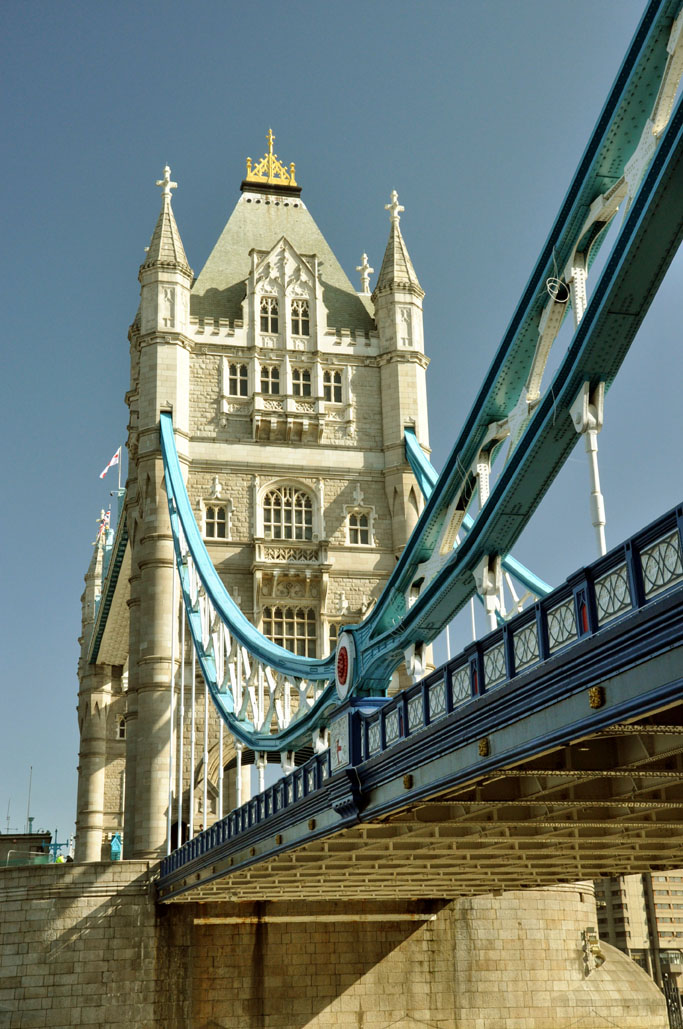
 Often mistaken for London Bridge, Tower Bridge is actually the internationally recognized landmark that crosses the River Thames. It took 8 years, 5 major contractors and 432 construction workers to build Tower Bridge. In 1876, a special committee was formed to find a solution to increased commercial activity in the east end of the City of London, and a competition was opened for the design of a new bridge. The chosen plans were by the City’s architect, Horace Jones, with John Wolfe Barry as the bridge’s engineer. At the time, Tower Bridge was the largest ‘bascule’ bridge ever built. The bridge’s bascules were operated by a sophisticated system of hydraulics and steam power, and it only took about a minute to raise the bascules to their maximum angle of 86 degrees. In its heyday, the bridge would open more than 6,000 times a year. Today, the bascules are still operated by hydraulic power, but since 1976 they have been driven by oil and electricity rather than steam, and the bridge now opens for river traffic only about 900 times a year. Tower Bridge was officially opened on 30 June 1894 by the Prince of Wales (the future King Edward VII), and in 1977, the bridge was painted red, white, and blue to celebrate Queen Elizabeth II’s Silver Jubilee. Visitors to London can tour the Tower Bridge Exhibition which charts the history of the bridge and enables visitors to see the original Victorian steam engines and take in panoramic views of the city from the bridge’s high level walkways. In July of 2009, Australian freestyle motocross star, Robbie Maddison, performed a spectacular no-handed backflip over an OPEN Tower Bridge at a speed of 40 mph, soaring nearly one hundred feet over the River Thames!
- Tower Bridge Exhibition
- Tower Bridge Road, London SE1 2UP
- www.towerbridge.org.uk
- Underground: Tower Hill